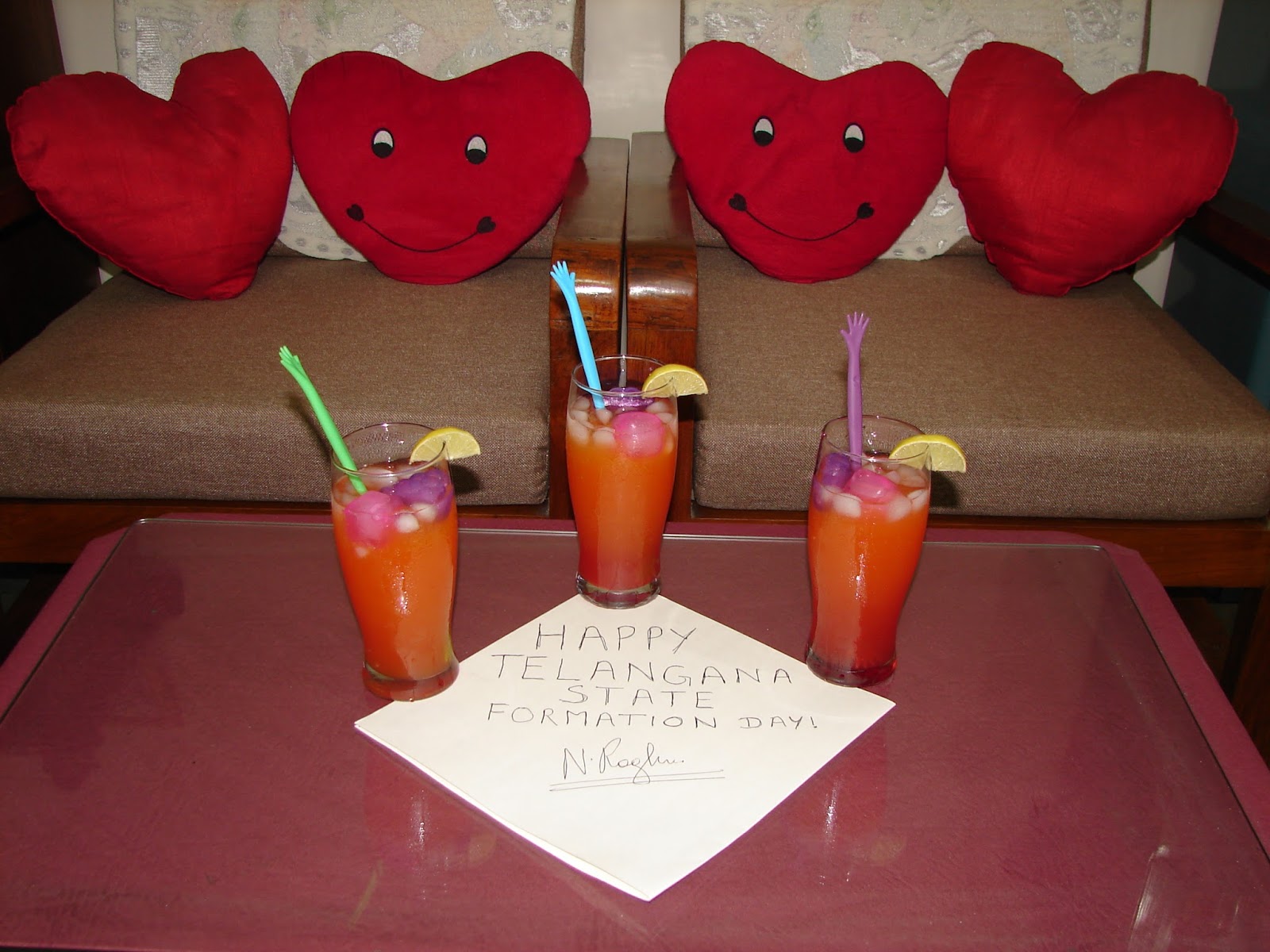
Today is the Third Anniversary of Telangana State Formation. It is
a holiday for all Government Offices and Undertakings and to many Private
Companies and Schools which have reopened early after summer vacation. There
were National Flag hoisting programs and cultural programs this morning in the
State Capital and all Districts of the State. Celebrations in different forms
are to take place in all districts for the next three days.
Food is an important part of any celebration and every festival in
all communities and nations of the world and perhaps a little more in
Telangana! So the Telangana State Tourism Development Corporation has lined up
a slew of activities, including Food Awards, with the Hotels and Restaurant’s
Association and with THE HINDU as a media partner. From today to 6th June, all
three, four and five-star hotels in the twin cities will serve delicacies of
Telangana and compete for 15 awards, including the ones for the best food
court, ambiance and creativity, best chef, food service and food festival. Food
Festival with a number of Food Courts and Cultural Programs has commenced today
at People’s Plaza on Necklace Road.
We too celebrated Telangana Formation Day by savoring authentic
local food of Palamuru in a rustic village atmosphere at Palamuru Grill
Restaurant in Madhapur, Hyderabad. Palamuru / Palamoor is the region adjacent
to Hyderabad City with a distinct spicy and hot cuisine. The meal consisted of
a platter of grilled Panneer, Potelu (Mutton) Chops, Fish, Prawns, Chicken and
Sheekh Kababs, Rumali Roti, Gadwal Pappu, Kunda Pulav – Mutton Pulav cooked in an
Earthen Pot in front of us, close to our Table. You can see all this and other
accompaniments in the attached photographs. And at home we had Sunrise
Mocktails and plenty of local delicious Mangoes with one special fruit weighing
over one kilogram!
It is three years since our State of Telangana is formed, after
decades of struggle on various platforms sometimes with very tragic and serious
consequences. Hundreds of persons have died in police firing and hundreds have
died out of frustration and others have suffered as politicians failed to
implement agreements and fooled people perennially by not keeping up their
promises on formation of Telangana State. And ultimately on 2nd June 2014
Telangana Statehood became a reality due to unyielding struggle of Telangana
people against many odds and villains. It was finally setting right the mistake
of 1st November 1956 and the victory of a just demand.
On this happy occasion I wish to express my heartfelt thanks to
everyone alive and martyred who contributed to the creation of our Telangana
State and to all those who are working for the development and prosperity of
our State.
This day and this week are grand celebration times for all people of
Telangana. There are a number of cultural programs and Telangana food festivals
being organized in Twin cities of Hyderabad and Secunderabad and in all the 31
districts of our State. Please check out these events and enjoy in any way you
like and of course even by watching the celebrations on TV.
Have A Nice Day! – Happy Telangana State Formation Day!!
Some songs stand the ‘Test of Time’, yet others fade into
obscurity. I am making this statement with specific reference to Telugu and
Hindi movie songs and I can guess same is the case with songs in all the
languages of the world.
Elsewhere in the world everlasting songs may be forth coming
copiously every year. But this is not the case with Telugu and Hindi movie
songs, most modern day songs are not good. Without naming great lyricists,
singers and music directors of bygone days; I can declare that songs of
yesteryears, majority of them are very popular even today, very melodious and
with great music and meaning.
Most modern songs, virtually all of them may have good singers but
the lyrics are difficult to understand in one hearing, they are mostly
meaningless and sometimes vulgar and always noisy with the cacophony of too
many loud and unnecessary instruments and the accompanying dances are unethical with vulgar gyrations.
There are hundreds of old evergreen songs in Telugu and Hindi but
here is one video song from the Hindi movie “Chalti Ka Naam Gaadi” of 1958,
which my children, Srikanth and Srinath loved to see often and repeatedly as
young children years ago, and then it was popular with my grandnephew, Vihaan
and today it is with my one and a half year old grandson, Atharv. My children
were never tired of listening to this song and today my grandson keeps coming
to me few times every day when I am at my desktop asking me to play this song
by uttering the words - Pom, pom, pom! And I have to obey him until he changes
his mind for something better to do in the house. It is now so popular with him
that he demands this song from his grandmother at the time of feeding him meals
and she has to play it for him on her mobile phone.
The title of the song is ‘Babu Samjho Ishare’, and as I mentioned
earlier it is from the movie ‘Chalti Ka Naam Gaadi’ of 1958. The singers are
Ashok Kumar (a great actor), Kishore Kumar (actor and a great singer) and Manna
Dey (another great singer). The Lyricist is Majrooh Sultanpuri and the Music Director
is Sachin Dev Burman and the Movie Director is Satyen Bose. And the actors in
this song are Ashok Kumar, Kishore Kumar and Anoop Kumar, all brothers!
Thanks to all these departed souls who continue to amuse our
children!
Bhubaneswar the capital of Odisha is a city of temples. Not only
from a religious point of view, several of these temples are important from an
architectural standpoint. The Lingaraja or Lingaraj temple - the largest of
these is a highly revered Shiva temple and it is an outstanding specimen of the
Orissa/Odisha style of temple building. It is over a thousand years old. Bhubaneswar,
Konark and Puri; the three temple towns constitute the Golden triangle of
Orissa. We are extremely happy to have visited these three significant, ancient
and historic places of pilgrimage, very recently.
Bhubaneswar is a highly revered pilgrimage centre since ancient
times. The Bramha Purana refers to Bhubaneswar as the Ekamra Kshetra enshrining
countless Shivalingas. More than 400 temples, dated between the 7th and 13th
centuries, remain here today out of the 7,000 that are once said to have dotted
the city. The total number of temples included in this area at one time, as
recorded in the hyperbolic language of Ekamra Purana, was a hundred thousand
while the Shivalingas numbered ten million (one crore)!
The extant temples were built largely by rulers of the
Shailobhava, Bhaumakara, Somavamshi and Ganga dynasties. The overwhelming
sanctity of the region led the rulers, driven by the hope of eternal blessings,
to vie with one another in building temples of all dimensions.
The Lingaraja temple is said to have been built first by the
ruler Yayati Kesari in the 7th century who shifted his capital from Jaipur to Bhubaneswar.
Bhubaneswar remained as the Kesari capital, till Nripati Kesari founded Cuttack
in the 10th century. According to an inscription on the wall of jagamohana, Lingaraja
temple is dated to the 11th century, to the reign of the Ganga king,
Anantavarman Chodaganga.
Lingaraja temple was originally known as Krittivasas and from
the very beginning, it has been the most revered temple in Bhubaneswar. The
crowning glory of the temple is its 55 metre (180 feet) tall great tower or
shikara of the deul that dominates not just the temple but also the town of Bhubaneswar.
‘In the elegance of its proportions and sculptural richness, it is one of the
most finished and refined manifestations of temple architecture in India’. The main temple consists of four structures,
all in the same axial alignment, viz., deul or Sri Mandir or Vimana,
jagamohana or the Hall (Mandapa), nata mandira or the Dancing Hall,
and bhoga mandapa or bhoga mandira or the Hall of offerings. And
surrounding the main temple are many minor temples in its vast courtyard
covering over 2,50,000 square feet. The Shivalingam in the sanctum of the
Lingaraja temple rises to a height of 8 inches above the floor level, and is 8
feet in diameter!
Legend has it that Shiva revealed to Parvati that Bhubaneswar -
or Ekamra Thirtha was a resort favoured by him over Banaras. Parvati in the
guise of a cowherd woman decided to look at the city herself. Two demons
Kritti and Vasa desired to marry her. She requested them to carry her upon
their shoulders and crushed them under her weight. Shiva, then created the
Bindu Saras Lake to quench her thirst and took abode here as Krittivasas or
Lingaraja. The vast Bindu Sagar Lake is the centre around which are located the
multitude of temples of Bhubaneswar. It
is believed that a Hindu pilgrimage to Bhubaneswar must begin with a dip in its
sacred waters followed by the worship of Lingaraja, to attain moksha or
liberation from the cycle of death and rebirth.
A total of 22 worship services are offered here each day and
there are several annual rituals. Once a year, an image of Lingaraja is taken
to the Jalamandir in the centre of the Bindu Sagar Lake. Every day over
6,000 pilgrims visit the temple and on special occasions, it is in several
thousands and on the occasion of Maha Shivaratri it touches 2 lakhs!