The
beaches of Pondicherry/Puducherry are very beautiful. Unfortunately the
coastline erosion along this coast is gradually affecting the beaches, I hope
this would stop or be a very gradual and prolonged process.
During
our recent five day visit to Pondicherry we stayed at The Ashok Beach Resort
for four days and at The French Villa for one day. The stay at The Ashok Beach
Resort was to our entire satisfaction. The resort has a private beach and we
stayed at a seaside cottage with 180 degrees view of the great ocean – the Bay
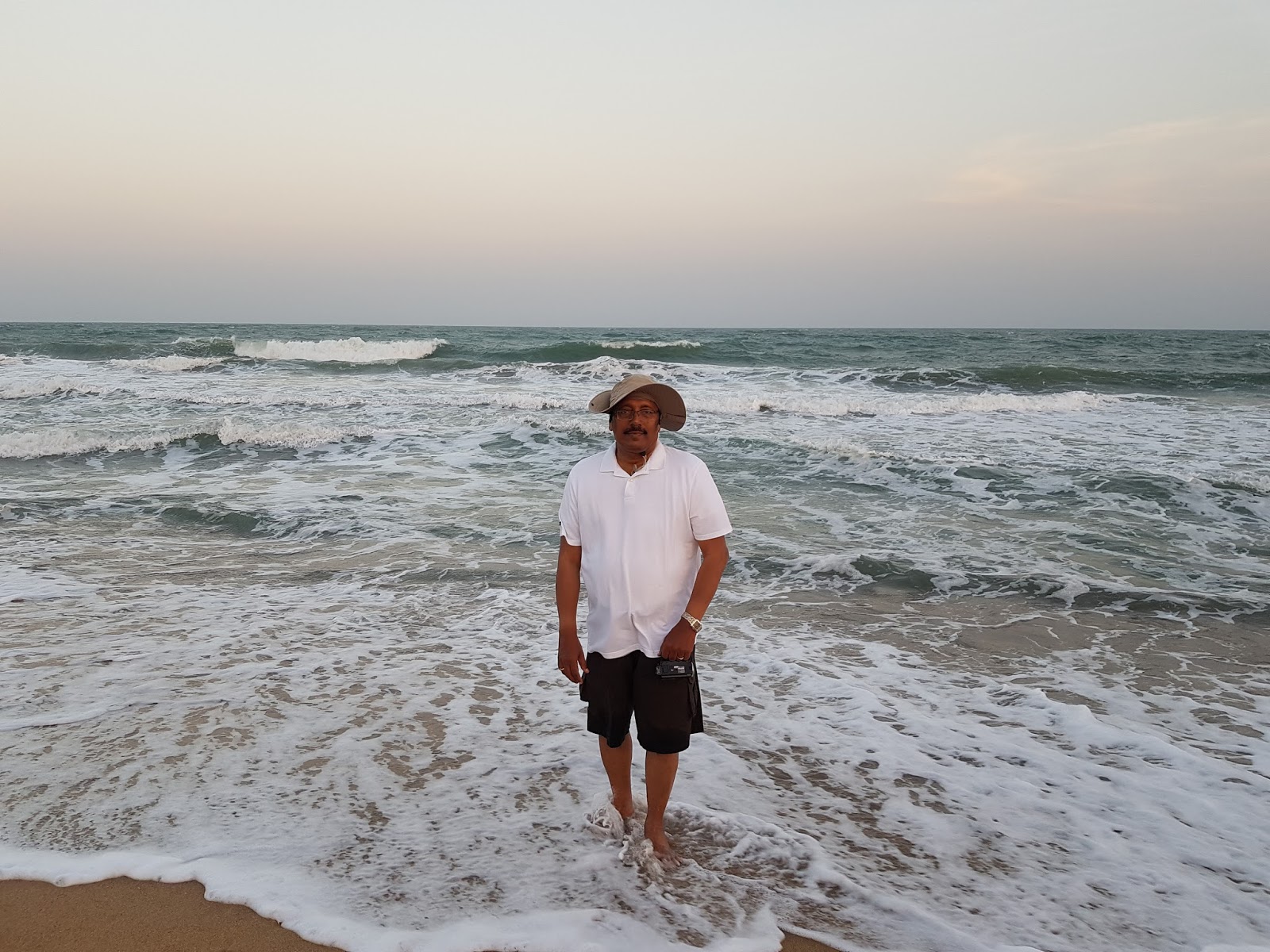
of Bengal. We enjoyed our walks on the
beach and the view and sound of the sea round the clock from our accommodation.
And the food was great. The attached video and photographs would introduce you
to this lovely beach resort.
The
Ashok Beach Resort is huge. It is an absolutely environment friendly location
spread over 65 acres and most of the area is overlooking the sea. The hotel is
a joint venture project of ITDC – India Tourism Development Corporation (Government
of India undertaking) and PIPDIC (Government of Pondicherry undertaking). It is
located along the East Coast Road a little away from the city close to
Pondicherry University in Kalapet area. So the beach here is called as Kalapet
beach.
The
weather was fine during our stay, rather very cold in the evenings. We were to
return to Hyderabad on the fourth day but due to overcast sky and resulting poor
visibility at Pondicherry airport our plane that was to take us to Hyderabad
could not land there and was diverted to Chennai. So we postponed our departure
to the next day and stayed at The French Villa, a heritage property in White
Town, very close to Promenade beach. As a result we got more time to enjoy
watching the sea and the Promenade area and the food available there.
We
have been to other beaches in Pondicherry that is Auro beach, Paradise beach and
the Promenade beach. I shall write later about these beautiful beaches along
with more pictures capturing the beauty of these places.
Here are some Photographs of our
Christmas Celebration this year at our house – Srilekha. An extremely happy
occasion, just as we wished…gifts from Santa Claus and Santa’s loving company,
presents we traded with family members, lots of laughter, a delicious Rich Plum
Cake and sumptuous food. I am sharing this in my blog with Hearty Season’s
Greetings to family, friends and other readers and hoping that these
photographs will add to their cheer.
Auroville is located in Tamil Nadu (some
parts are in the State of Puducherry), a few kilometres inland from the Bay of
Bengal, approximately 150 kms south of Chennai and 10 kms north of the town of
Pondicherry now being called as Puducherry. Auroville means – The City of Dawn.
I visited Auroville few years ago and very
recently along with my wife on 18th December’17. Auroville is a universal
township in the making for a population of up to 50,000 people from around the
world.
The concept of Auroville - an ideal township
devoted to an experiment in human unity - came to the Mother of the Sri Aurobindo
Ashram as early as the 1930s. In the mid 1960s the concept was developed and
put before the Govt. of India, who gave their backing and took it to the
General Assembly of UNESCO. In 1966 UNESCO passed a unanimous resolution
commending it as a project of importance to the future of humanity, thereby
giving their full encouragement.
The purpose of Auroville is to realise human
unity – in diversity. Today Auroville is recognised as the first and only
internationally endorsed ongoing experiment in human unity and transformation
of consciousness, also concerned with - and practically researching into -
sustainable living and the future cultural, environmental, social and spiritual
needs of mankind.
On 28th February 1968 some 5,000 people
assembled near the banyan tree at the centre of the future township for an
inauguration ceremony attended by representatives of 124 nations, including all
the States of India. The representatives brought with them some soil from their
homeland, to be mixed in a white marble- clad, lotus-shaped urn, now sited at
the focal point of the Amphitheatre. At the same time the Mother gave Auroville
its 4-point Charter.
Aurovilians come from some 49 nations, from
all age groups (from infancy to over eighty, averaging around 30), from all
social classes, backgrounds and cultures, representing humanity as a whole. The
population of the township is constantly growing, but currently stands at
around 2,500 people, of whom approximately one-third are Indian.
At the centre of the township lies the Peace
Area, comprising the Matrimandir – meaning Temple of the Mother and
its gardens, the amphitheatre with the Urn of Human Unity that contains the
soil of 121 nations and 23 Indian states, and the project of a lake to help
create an atmosphere of calm and serenity and to serve as a groundwater
recharge area. Matrimandir is an edifice of spiritual significance for
practitioners of Integral yoga, initiated by The Mother of the Sri Aurobindo
Ashram. It is called soul of the city; it does not belong to any particular
religion or sect.
The Matrimandir took 37 years to build, from
the laying of the foundation stone at sunrise on 21st February 1971 - the
Mother’s 93rd birthday - to its completion in May 2008. It is in the form of a
huge sphere surrounded by twelve petals. The Geodesic dome is covered by golden
discs and reflects sunlight, which gives the structure its characteristic
radiance. 56 kgs of gold has been used for the covering of the dome. Inside
this central dome is a meditation hall known as the inner chamber - this
contains the largest optically-perfect glass globe in the world. The
Matrimandir, and its surrounding gardens in the central Peace Area, is open to
the public by appointment.
The four main pillars that support the
structure of Matrimandir, and carry the Inner Chamber, have been set at the
four main directions of the compass. These four pillars are symbolic of the
four aspects of the mother as described by Sri Aurobindo, and are named as
Maheshwari (south pillar), Mahakali (north pillar), Mahalakshmi (east pillar)
and Mahasaraswati (west pillar).
A 109-hectare area to the north of the Peace
Area, the Industrial Zone, a zone for "green" industries, is
focused on Auroville's efforts towards a self-supporting township. It will
contain small and medium-scale industries, training centres, arts and crafts,
and the city's administration.
The largest of the four city zones,
comprising of 189 hectares, the Residential Zone is bordered by parks on
the north, south and west. Main access to the zone will be through the crown
road with further traffic distribution via five radial roads that divide the
zone into sectors of increasing densities. This zone wants to provide a
well-adjusted habitat between individual and collective living. 55% of the area
will be green and only 45% built surface, thereby creating an urban density
balanced by nature.
The International Zone, a zone of 74
hectares to the west of the Peace Area, will host national and cultural
pavilions, grouped by continents. Its central focus is to create a living
demonstration of human unity in diversity through the expression of the genius
and contribution of each nation to humanity
Planned on a 93-hectare area, situated to the
east of the Peace Area, the Cultural Zone will be a site for applied
research in education and artistic expression. Facilities for cultural,
educational, art and sports activities will be located in this zone.
The city area with a radius of 1.25 km. will
be surrounded by a Green Belt of 1.25 km width. As a zone for organic
farms, dairies, orchards, forests, and wildlife areas, this belt will act as a
barrier against urban encroachment, provide a variety of habitats for wildlife,
and serve as a source for food, timber, medicines etc. and as a place for
recreation.
Presently an area of 405 hectares, the Green
Belt - though incomplete - stands as an example of successful transformation of
wasteland into a vibrant eco-system. Its further planned extension with an
additional 800 hectares will make it into a remarkable demonstration site for
soil and water conservation, ground water recharge, and environmental
restoration. As lungs for the entire township, it will complete the healing
process that Auroville started several decades ago.





 VIDEO:


